Automatic
Follow-Up.
Never Let Another Opportunity Slip Away
Our smart follow-up automation nurtures every lead with personalized messages, appointment reminders, and timely check-ins—helping you close more sales without adding extra work.


Websites

Local SEO

AI Chat
Appointments

Lead Funnels
Automation
Choose Your Growth Plan
Customer Follow Up Automation for Contractors
Every plan includes setup, optimization, AI support, and unlimited updates. No contracts. Cancel anytime.

A missed call at 4:47 PM can turn into a lost $12,000 job by 5:15. That is the reality for busy service businesses, and it is exactly why customer follow up automation for contractors has moved from a nice-to-have tool to a revenue system. If your team is juggling estimates, job sites, scheduling changes, and inbound calls, manual follow-up is not just inefficient - it is expensive.
Most contractors do not have a lead problem. They have a response problem. The phone rings while the owner is driving. A form submission comes in after hours. Someone asks for pricing, gets busy, and forgets to call back. A past customer means to book seasonal service but never gets reminded. These are not rare situations. They happen every day, and they create a gap between demand and actual booked revenue.
Why customer follow up automation for contractors matters
Contractors operate in a speed-driven market. The first company to respond often wins the job, even before price becomes the deciding factor. Homeowners want answers fast. Commercial clients want professionalism and consistency. If your business replies two hours later and your competitor replies in two minutes, you are already behind.
Automation changes that equation. Instead of relying on memory, sticky notes, voicemail, or an overloaded office manager, your follow-up process runs on schedule. New leads get immediate acknowledgment. Missed calls trigger text messages. Estimate requests move into a sequence instead of disappearing into a spreadsheet. Review requests go out after completed jobs. The result is not just convenience. It is tighter lead handling, better close rates, and fewer revenue leaks.
That said, automation is not magic. If your messaging sounds robotic or your process is badly timed, it can create friction. The goal is not to replace human communication. The goal is to make sure the right communication happens every time.
Where contractors usually lose the sale
The biggest breakdown usually happens between first contact and actual booking. A prospect calls and no one answers. They fill out a website form and wait too long for a response. They receive an estimate but hear nothing for days. Or they become a customer once and then never hear from the company again.
For HVAC companies, this often shows up during peak season when call volume spikes and the office cannot keep up. For plumbers, it happens after emergency calls when follow-up for non-urgent jobs falls through the cracks. For remodelers and residential contractors, it shows up in estimate follow-up, where warm leads go cold because nobody had time to send the second or third touch.
This is why disconnected software hurts growth. If your phone system, CRM, email tool, calendar, and website forms do not talk to each other, every lead handoff becomes a risk point. People assume someone else followed up. Nobody actually did.
What good follow-up automation looks like
Strong automation feels fast, relevant, and personal enough to keep the conversation moving. It should respond the moment a lead comes in, route the inquiry into one system, and trigger the next step based on what the prospect does.
A simple example is missed-call text back. If someone calls while your team is on another line or out in the field, they immediately receive a text asking how you can help and offering the next step. That one workflow alone can recover leads that would otherwise call the next contractor on Google.
Another high-value sequence starts when someone requests an estimate. They get a confirmation right away, then a reminder if they have not booked, then a follow-up after the estimate is delivered. If they still do not respond, the system can check in again a few days later. Done well, this keeps your pipeline active without forcing your staff to manually chase every opportunity.
Past-customer automation matters too. Most contractors focus heavily on new leads and ignore repeat business. That is a mistake. Service reminders, maintenance prompts, seasonal check-ins, and review requests can generate revenue from people who already know and trust your company.
The core workflows worth automating first
If you are starting from scratch, do not automate everything at once. Start with the places where money is most likely slipping through the cracks.
Missed call recovery is usually first because the return is immediate. A contractor who misses even five qualified calls a week is leaving real money on the table. Website lead response is next, especially if your site is generating traffic from local SEO or paid campaigns. Estimate follow-up comes right after that, because many businesses spend money getting leads only to lose them after the quote goes out.
Appointment reminders also deserve attention. They reduce no-shows, cut rescheduling friction, and create a better customer experience. After-job review requests are another smart move because they build online reputation, which directly affects local search performance and conversion.
The exact order depends on your business model. A service company with heavy inbound call volume may prioritize missed calls. A remodeler with longer sales cycles may get more value from estimate and pipeline follow-up. The right answer is based on where delay is hurting revenue the most.
Automation should support your sales process, not fight it
This is where some contractors get burned. They buy software, turn on a few generic templates, and wonder why the results are weak. Automation only works when it matches how your business actually sells.
If your jobs require quick phone qualification, the automation should push toward a call or booking link fast. If your sales process depends on in-home estimates, the follow-up should reduce drop-off between inquiry and scheduled appointment. If your service area is limited to Detroit, Taylor, and nearby markets, your messaging should reflect that so leads know right away you serve them.
Tone matters too. A roofing prospect after a storm needs urgency. A bookkeeping lead may respond better to a more measured, professional cadence. The system should fit the customer journey, not force every lead through the same script.
Why an all-in-one system beats stacked tools
Many contractors end up with a patchwork setup: one platform for forms, another for email, another for texting, another for reviews, another for scheduling, and maybe a spreadsheet on top of all that. It looks manageable until something breaks or a lead falls between systems.
An integrated platform changes the economics. Your website, lead capture, CRM, booking calendar, SMS, email, and review workflows work from the same data. That means faster follow-up, better visibility, and less manual cleanup for your team. It also cuts down on duplicate subscriptions and the constant friction of jumping between tools.
This is especially important for owner-operators and small office teams. When one person is acting as dispatcher, sales coordinator, and customer service rep, efficiency is not a luxury. It is survival.
The real payoff: speed, consistency, and scale
Customer follow up automation for contractors is not just about sending texts. It is about building a business that responds like a serious company every single time. Speed gets more leads into conversation. Consistency keeps opportunities from getting forgotten. Scale lets you grow without adding chaos.
There is also a leadership advantage here. When follow-up is systemized, the owner stops carrying the whole communication process in their head. Staff can work from a clear pipeline. Managers can see where leads are stalling. Marketing becomes more measurable because you can trace inquiries through to booked jobs.
That visibility matters. If leads are coming in but not converting, you need to know whether the issue is response time, weak messaging, scheduling friction, or bad lead quality. Automation gives you cleaner data, and cleaner data leads to better decisions.
What to watch before you roll it out
Do not over-automate. If every interaction feels canned, your brand loses trust. Keep messages short, useful, and action-oriented. Use automation for speed and consistency, then let your team take over where real conversation matters.
You also need clean intake. If your forms collect bad information or your pipeline stages are a mess, automation will just move confusion faster. Before building workflows, make sure your lead sources, contact records, and next steps are clearly defined.
And remember that follow-up timing is not one-size-fits-all. Emergency plumbing and kitchen remodeling should not use the same cadence. Better automation is not always more automation. It is smarter automation.
For contractors who want growth without more dropped balls, this is one of the highest-leverage upgrades available. The businesses winning right now are not just generating leads. They are building systems that answer faster, follow up better, and keep every opportunity moving. If your current process depends on someone remembering to call back later, you do not have a process yet - you have a risk.
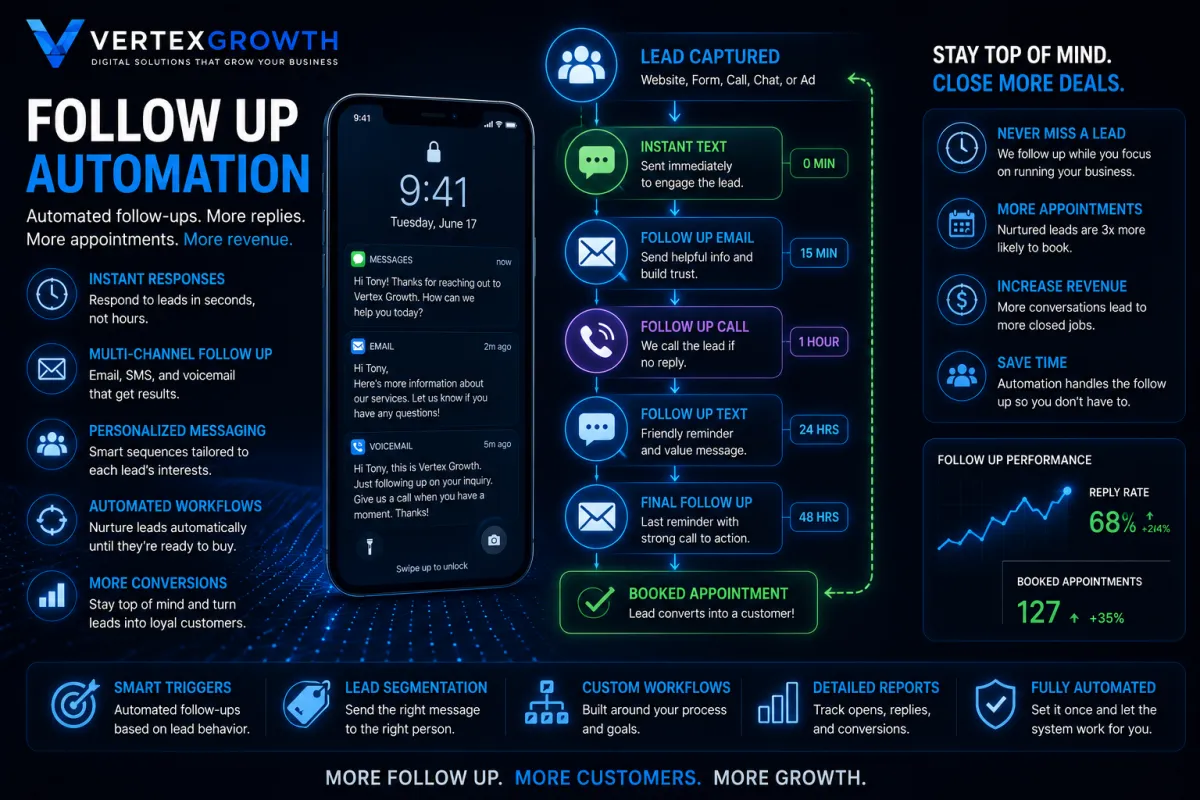
Automatic Follow-Up
Your Business Never Stops.
Neither Does Your Follow-Ups.
Stay Connected Until They Say Yes
Automatically follow up with leads and customers through text messages, emails, and reminders—keeping your business top of mind while increasing appointments, conversions, and repeat customers.
Instant Text
Follow-up Email
Never Miss a Lead
Save Time
Personalized Messaging
Custom Workflows
Helping Local Businesses Grow Every Day




What Our Clients Are Saying
Frequently Asked Questions
Do I have to sign a contract?
No. Every plan is month-to-month and you can cancel anytime.
How long does it take to build my website?
Most websites are completed within 7–14 business days.
Does the AI Receptionist answer calls?
Yes. It answers calls, texts, website chats, qualifies leads, and books appointments.
Can I keep my existing website?
Absolutely. We can improve your current website or build a completely new one.
Will my business show up on Google?
Yes. Every plan includes Google Business Profile optimization and Local SEO.
Do you provide support?
Yes. We provide ongoing updates, maintenance, hosting, and technical support.
Can I upgrade later?
Absolutely. You can upgrade to Rapid Growth or Accelerated Growth at any time.