
Smart Websites That
Grow Your Business.
Your website should do more than look professional—it should become your hardest-working employee. At Vertex Growth, we build intelligent, high-converting websites designed to attract more local customers, capture every lead, and turn visitors into paying clients.
Our smart websites combine beautiful modern design with powerful automation, AI technology, SEO optimization, online scheduling, live chat, CRM integration, and mobile responsiveness. Every page is strategically built to increase calls, generate qualified leads, and help your business grow without adding more manual work.
Whether you're an HVAC contractor, plumber, roofer, electrician, accountant, or another local service business, your website will be optimized to rank higher in search results, respond instantly to new inquiries, and keep your sales pipeline moving 24/7.

Websites

Local SEO

AI Chat

Appointments

Lead Funnels

Automation
Smart Websites That Grow Your Business
Smart Websites for Local Businesses That Win
Every plan includes setup, optimization, AI support, and unlimited updates. No contracts. Cancel anytime.

A local customer lands on your website at 9:17 p.m. after searching for a plumber, HVAC repair company, or roofing contractor near them. They need help now. If your site only shows a phone number and a contact form that nobody checks until morning, that lead is already halfway to your competitor.
That is why smart websites for local businesses are no longer a nice upgrade. They are revenue systems. A smart website does more than look professional. It captures leads, responds fast, books appointments, follows up automatically, and gives owners a clearer view of what is actually driving growth.
For contractors and service businesses in places like Detroit, Taylor, and surrounding Michigan markets, speed matters. Follow-up matters. Visibility matters. If your website is not helping you do those things better, it is not doing its job.
What makes smart websites for local businesses different?
A standard website is basically a digital brochure. It tells people who you are, what you do, and maybe how to contact you. That was enough when most referrals happened offline and customers were willing to leave a voicemail and wait.
That is not how local buying behavior works now. People search, compare, click, and expect an answer fast. A smart website is built around that reality. It combines design, conversion strategy, local SEO structure, and automation so the site becomes part of your sales process instead of just a passive online presence.
For a local service business, that usually means the website can do a few critical things at once. It needs to rank for the services and cities you care about. It needs to make it easy for visitors to call, message, or book. It needs to route those leads into one central system. And it should trigger immediate follow-up so opportunities do not die in a missed call log or a forgotten inbox.
That difference matters because most small businesses are not losing money from lack of effort. They are losing money from broken systems.
Your website should reduce missed revenue, not create more of it
A lot of business owners assume their problem is traffic. Sometimes it is. But often the bigger issue is what happens after the click.
If your Google Business Profile, local SEO, or paid traffic gets someone to your site and the site does not convert, the marketing spend is wasted. If the visitor calls after hours and nobody answers, the chance is weakened. If they fill out a form and wait six hours for a response, you are already late.
This is where smart websites for local businesses create a competitive edge. They are designed to shorten the gap between interest and action. That can mean instant form responses, automated text confirmations, integrated booking calendars, AI receptionists, live chat workflows, or call tracking tied directly into a CRM.
The practical benefit is simple. You stop relying on memory, sticky notes, and whatever app your office manager happened to open that day. The lead gets captured. The customer gets a response. Your team gets visibility.
For a plumber, that could mean a homeowner requesting service at night and receiving an immediate text that confirms the request and offers next-step scheduling. For a bookkeeper, it could mean a prospect booking a consultation without back-and-forth emails. For an HVAC company, it could mean missed calls triggering an automated callback text so the lead is not lost while crews are in the field.
SEO is stronger when the website is built for local intent
A smart website is not just about automation. It also gives local SEO a stronger foundation.
Many small business sites are built with generic pages, weak service descriptions, and no real location strategy. They might look decent, but they are not organized around how local customers search. If you want to show up for service-based searches in your market, the website needs clear service pages, location relevance, proper technical setup, and strong conversion pathways.
That does not mean stuffing city names everywhere. It means building a site that aligns with real search intent. Someone searching for emergency furnace repair in Detroit is not looking for a vague homepage with a stock photo and a slogan. They want proof that you handle the service they need, in the area they are in, and that you can respond fast.
A smart website supports that with cleaner architecture, more purposeful page structure, better mobile usability, faster load times, and content that matches buyer intent. It also makes tracking easier, so you can see which pages are generating calls, form fills, and booked jobs instead of guessing based on traffic alone.
The best local websites connect to your operations
This is where a lot of business owners get frustrated. They have one platform for the website, another for forms, another for email, another for reviews, another for scheduling, and maybe a spreadsheet holding everything together in the background.
That setup creates delays and data gaps. It also makes growth harder because every new lead has to move through a maze of disconnected tools.
A smarter approach is integration. When your website connects directly with your CRM, calendars, SMS follow-up, email sequences, and customer communication tools, your business runs faster. You reduce duplicate work. Your team sees the same customer data. Follow-up becomes more consistent.
There is a trade-off, of course. All-in-one systems require better setup on the front end. You have to think through workflows, lead routing, and customer communication standards. But that upfront effort pays off because the business becomes easier to manage at scale.
For owner-operators, that means fewer manual tasks at the end of a long day. For growth-minded companies, it means a stronger foundation for adding techs, office staff, and new service areas without creating chaos.
What local business owners should expect from a smart website
If you are investing in a new site, the standard should be higher than clean design and mobile responsiveness. Those are basics.
A smart website should help generate and manage demand. It should make calling, booking, and messaging frictionless. It should support local SEO performance. It should connect to automation that improves response times. And it should give you usable reporting, not vanity metrics.
That might include click-to-call design for mobile users, quote request funnels by service type, missed-call text back, appointment scheduling, automated review requests, and lead tracking tied to the original source. If you run a service business where speed and follow-up affect close rates, these features are not extras. They are part of modern sales infrastructure.
It also needs to reflect how your customers actually buy. Some local businesses do better with direct phone calls. Others need stronger form flows because customers are comparing options after hours. Some businesses need financing prompts, service area pages, or review-heavy layouts to build trust faster. There is no one-size-fits-all formula, which is why strategy matters more than flashy design.
Why local businesses are moving away from brochure websites
Brochure websites usually fail in the same predictable ways. They look fine, but they are slow to update, hard to track, disconnected from follow-up systems, and weak at converting traffic. They create the appearance of professionalism without giving the business much operational advantage.
That is a problem because your competitors are getting more sophisticated. They are not just paying for traffic. They are building systems that answer leads faster, automate routine communication, and keep the pipeline moving.
The local businesses that win over the next few years will not necessarily be the biggest. They will be the ones with the fastest and most organized response systems. A smart website is part of that shift. It helps smaller operators compete like larger companies because it replaces manual gaps with process.
That is one reason companies like Vertex Growth LLC focus on websites as part of a broader growth system instead of treating them like standalone design projects. For local service businesses, the site works best when it is tied to lead handling, automation, and day-to-day execution.
The real question is not whether you need a better website
The real question is whether your current website helps you close more business.
If it does not improve lead flow, response time, booking efficiency, and visibility in local search, then it is costing you more than it is helping you. A smart website earns its place by making the business faster, easier to manage, and more consistent at turning attention into revenue.
That is the shift local owners need to make. Stop thinking of the website as an online brochure. Start treating it like a working part of your sales and operations engine.
When your site can capture, respond, schedule, and support your local ranking strategy at the same time, you are no longer just online. You are built to compete.
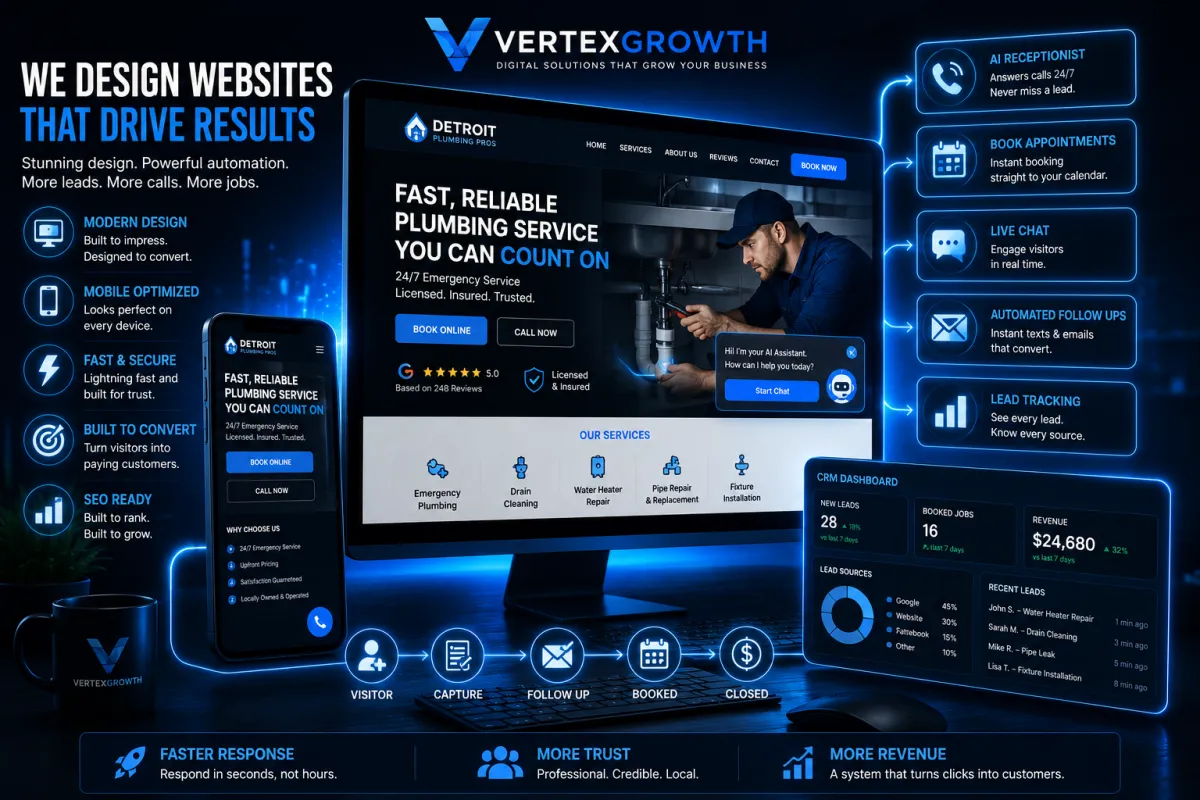
Smart Websites
Your Business Never Stops.
Neither Does Your Smart Website
Capture every lead 24/7 with an intelligent AI receptionist that answers calls, responds instantly to texts and website chats, qualifies prospects, books appointments, and follows up automatically—so you never lose another customer to voicemail.
Answer calls 24/7
Replies instantly to text & website chats
Qualifies every lead automatically
Books appointments directly on your calendar
Sends reminders and follow-ups automatically
Integrates with your CRM automations
Helping Local Businesses Grow Every Day





What Our Clients Are Saying
Frequently Asked Questions
Do I have to sign a contract?
No. Every plan is month-to-month and you can cancel anytime.
How long does it take to build my website?
Most websites are completed within 7–14 business days.
Does the AI Receptionist answer calls?
Yes. It answers calls, texts, website chats, qualifies leads, and books appointments.
Can I keep my existing website?
Absolutely. We can improve your current website or build a completely new one.
Will my business show up on Google?
Yes. Every plan includes Google Business Profile optimization and Local SEO.
Do you provide support?
Yes. We provide ongoing updates, maintenance, hosting, and technical support.
Can I upgrade later?
Absolutely. You can upgrade to Rapid Growth or Accelerated Growth at any time.