
Never Lose Another
Lead Again.
Capture every phone call, website form, text message, and chat request automatically. Instantly follow up, book appointments, and organize every opportunity in one AI-powered system—24 hours a day.


Websites

Local SEO

AI Chat

Appointments

Lead Funnels
Automation
Never Lose Another Lead Again.
Lead Capture Automation That Wins More Jobs
Every plan includes setup, optimization, AI support, and unlimited updates. No contracts. Cancel anytime.

A homeowner finds your business on Google at 8:17 p.m., calls for help, gets voicemail, and moves on to the next company. That is exactly where revenue disappears, and it is why lead capture automation matters. If your business depends on inbound calls, web forms, quote requests, and appointment bookings, every delay between interest and response costs money.
For local service businesses, this is not a marketing theory problem. It is an operations problem. Plumbers, HVAC companies, roofers, bookkeepers, electricians, and home service teams do not lose leads because demand is missing. They lose leads because the process is broken. Phones go unanswered. Form submissions sit in inboxes. Staff forget to call back. Customer information ends up spread across too many tools. Lead capture automation fixes that by turning interest into action the moment a prospect reaches out.
What lead capture automation actually does
At its core, lead capture automation collects prospect information and triggers the next step without waiting for a person to notice it first. That next step might be a text message, an email, a call routing action, a booking prompt, a CRM entry, or a task assignment for your team.
A lot of business owners hear the word automation and think of complicated software projects or enterprise systems built for giant companies. That is not the point here. For a local business, lead capture automation should be simple, fast, and tied directly to booked work. If someone calls after hours, the system should respond. If someone fills out a quote form, the system should confirm receipt and move the lead into follow-up. If someone clicks on an ad and lands on a page for emergency service, the system should make it easy to schedule immediately.
This is where automation becomes practical instead of technical. It reduces response time, cuts down on manual tasks, and keeps your lead flow organized in one place.
Why local businesses lose leads before the sales process starts
Most companies think they have a lead generation problem when they really have a lead handling problem. They spend on SEO, paid ads, local service visibility, and website traffic, but the back end is weak. The result is a leaky pipeline.
Missed calls are the obvious issue, but they are not the only one. A slow response to a form inquiry can be just as expensive. People searching for a contractor or service provider are usually comparing a few options at once. The business that answers first, follows up first, and makes booking easiest often wins.
There is also the software problem. One tool handles forms. Another handles email. Another sends texts. Another tracks appointments. Another stores customer notes. When systems are disconnected, your team spends more time chasing information than closing jobs. Lead capture automation works best when it connects these functions instead of stacking more apps on top of the mess.
Lead capture automation works best when speed and structure work together Speed matters, but speed alone is not enough.
Sending an instant text is useful, but if the lead then disappears into a spreadsheet or inbox, you still have a process gap. The best setups combine immediate response with clear structure.
That means every new lead should be routed into a central system, tagged by source, and pushed into a next step. A missed caller should get a text back fast. A web form lead should receive confirmation and a path to book. A high-intent inquiry should notify the right team member right away. If no one responds, the system should keep following up instead of hoping someone remembers later.
For a contractor or service business, that structure creates leverage. You do not need more chaos handled faster. You need a system that captures demand, organizes it, and keeps momentum moving until the lead either books or opts out.
Where lead capture automation has the biggest impact
The biggest wins usually happen in four places: phone calls, website forms, booking workflows, and follow-up.
Phone calls are still one of the highest-value lead sources for local businesses. If your business gets emergency calls, estimate requests, or service inquiries, missed-call recovery can recover revenue that would otherwise disappear. An automated text that goes out the moment a call is missed can save the opportunity and start the conversation.
Website forms matter because not every prospect wants to call first. Some want to request a quote at night, during work hours, or while comparing providers quietly. The moment they submit a form, they should hear back. Not tomorrow. Not after somebody checks the inbox. Right then.
Booking workflows are where many companies still create friction. If a lead has enough intent to schedule, your system should help them do it. That does not mean every business needs fully open calendar scheduling. Sometimes it makes sense to request preferred times and confirm manually. It depends on your service model. But the handoff should still be fast and organized.
Follow-up is where automation often pays for itself. A lot of leads do not book on the first touch. They need a reminder, a check-in, or a second chance to respond. Automated text and email sequences keep those opportunities alive without burying your staff in repetitive work.
What a good system looks like in the real world
A strong lead capture automation setup is not flashy. It is reliable. It starts the moment someone reaches out and keeps going until the lead is properly handled.
A homeowner submits a form for AC repair. They get an immediate confirmation text. Their information lands in the CRM automatically. The office team gets notified. If the lead does not book within a set time, a follow-up message goes out. If they reply, the conversation stays attached to the same record instead of getting lost across phones and inboxes.
That is the difference between having traffic and having a system. A high-traffic website means very little if your business responds like it is still running on sticky notes, voicemail, and memory.
This is also why all-in-one platforms are gaining traction with local service companies. When websites, forms, SMS, email, calendars, reputation tools, and CRM live in one connected environment, lead capture automation becomes easier to manage and easier to trust. Vertex Growth LLC is built around that exact model because small businesses do not need more disconnected subscriptions. They need one machine that helps them win faster.
The trade-offs business owners should understand
Automation is not a replacement for judgment. It is a replacement for delay, inconsistency, and repetitive admin work. That distinction matters.
If your automations are too aggressive, leads can feel like they are talking to a machine instead of a business. If your messages are too generic, they will not convert well. If every lead goes into the same sequence regardless of service type or urgency, you can create confusion instead of momentum.
That is why the best lead capture automation is tailored. A bookkeeping inquiry should not get the same response flow as a midnight plumbing emergency. A roofing estimate request may need a longer nurture process than a same-day HVAC repair call. Automation should support the sales process you actually run, not force your business into a canned template.
There is also an internal trade-off. Once your system starts catching leads more effectively, your team still has to handle the increased volume. Better capture exposes weak sales follow-up, scheduling bottlenecks, and poor pipeline visibility. That is a good problem, but it is still a real one.
How to know if your business needs better lead capture automation
If you are asking staff to check multiple inboxes, monitor voicemails manually, copy customer details between tools, or remember who needs a callback, the answer is yes.
If your response times depend on who is in the office, the answer is yes. If you are paying for traffic but cannot clearly track where leads came from or what happened next, the answer is definitely yes.
The clearest sign is simple: you know leads are coming in, but your close rate is lower than it should be. In local markets like Detroit, Taylor, and surrounding Michigan communities, competition is not just about who ranks first. It is about who responds first and follows through.
What to focus on first
Start with the biggest leak, not the fanciest feature. For some businesses, that is missed-call text back. For others, it is fixing web form response time. For others, it is centralizing lead data so the team can actually see the pipeline.
Then build around revenue events. Capture the lead, respond instantly, route it correctly, make booking easier, and follow up until there is a clear outcome. That sequence beats random automation every time.
The goal is not to look high-tech. The goal is to stop leaving money on the table because your business is too busy to respond like a business that wants to grow.
Lead capture automation gives local companies a way to compete with more speed, more consistency, and less manual chaos. When your systems do the first part of the work immediately, your team can focus on the part that actually closes the job.
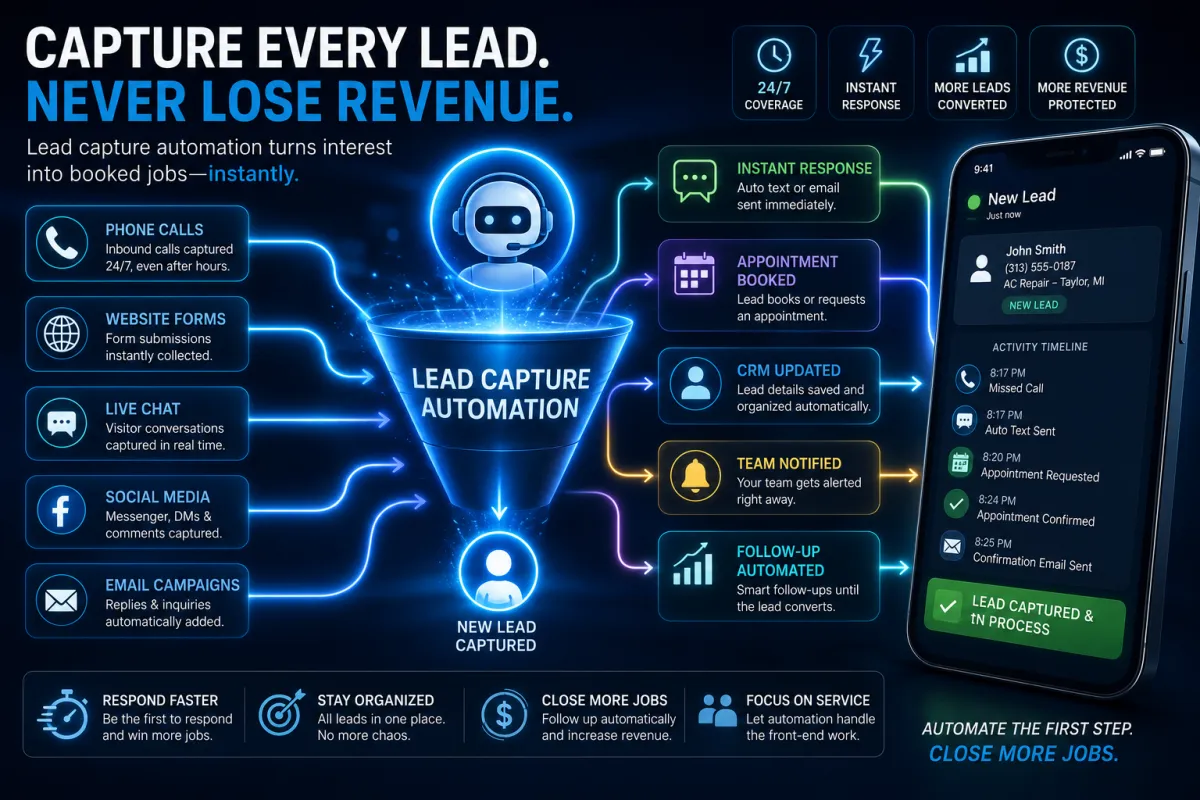
Lead Capture Automation
Your Business Never Stops.
Neither Does Your Automation
Capture every lead 24/7 with an intelligent AI receptionist that answers calls, responds instantly to texts and website chats, qualifies prospects, books appointments, and follows up automatically—so you never lose another customer to voicemail.
Respond Faster
Stay Organized
Close More Jobs
Focus on Service
CRM Updated
Team Notification
Helping Local Businesses Grow Every Day





What Our Clients Are Saying
Frequently Asked Questions
Do I have to sign a contract?
No. Every plan is month-to-month and you can cancel anytime.
How long does it take to build my website?
Most websites are completed within 7–14 business days.
Does the AI Receptionist answer calls?
Yes. It answers calls, texts, website chats, qualifies leads, and books appointments.
Can I keep my existing website?
Absolutely. We can improve your current website or build a completely new one.
Will my business show up on Google?
Yes. Every plan includes Google Business Profile optimization and Local SEO.
Do you provide support?
Yes. We provide ongoing updates, maintenance, hosting, and technical support.
Can I upgrade later?
Absolutely. You can upgrade to Rapid Growth or Accelerated Growth at any time.