Never Miss Another
Customer Call Again.
AI-powered websites, SEO, automation, chat widgets, and AI receptionist systems that help local businesses generate more leads, book more appointments, and grow without adding payroll.


Websites

Local SEO

AI Chat

Appointments

Lead Funnels

Automation
Never Miss Another Customer Call Again.
What Does an AI Receptionist Do?
Every plan includes setup, optimization, AI support, and unlimited updates. No contracts. Cancel anytime.

A missed call from a homeowner with a leaking pipe or a broken furnace is not a small problem. It is lost revenue. If you run a local service business, that is the real answer behind the question, what does an AI receptionist do. It helps you stop missing opportunities when your team is busy, after hours, or stuck juggling too many tools at once.
For contractors, plumbers, HVAC companies, and other service businesses, the phone is still one of the fastest paths to a booked job. But most owners are not sitting at a desk waiting to answer every call. They are in the field, managing crews, handling estimates, and putting out fires. An AI receptionist steps in to answer, respond, qualify, and route those conversations so leads do not disappear into voicemail.
What does an AI receptionist do for a small business?
At the most practical level, an AI receptionist handles the front-desk communication work that usually causes bottlenecks. It answers inbound calls, responds to basic questions, captures lead details, books appointments, sends follow-up messages, and routes urgent issues to the right person.
That sounds simple until you look at what it fixes. Most local businesses lose leads in a few predictable ways. Calls come in after hours. Staff members miss ringing phones while helping customers. Voicemails pile up. Web inquiries sit unanswered. A prospect contacts three companies and hires the one that responded first. In that environment, speed matters more than good intentions.
An AI receptionist is built to respond immediately. It does not need lunch, it does not call in sick, and it does not forget to follow up with someone who asked for an estimate yesterday.
The core jobs an AI receptionist handles
The best way to understand what an AI receptionist does is to look at the tasks that normally eat up time inside a service business.
Answering calls when your staff cannot
This is the big one. An AI receptionist can answer incoming calls instantly, even during evenings, weekends, and high-volume periods. Instead of forcing callers to leave a voicemail and hope for a callback, it can greet them, ask what they need, and keep the conversation moving.
For a plumbing company, that might mean identifying whether the caller has an emergency.
For an HVAC company, it might mean asking about system issues, location, and preferred scheduling times.
For an accounting or bookkeeping office, it might mean collecting contact information and the reason for the inquiry before routing the lead properly.
That alone can protect a lot of revenue. If your business depends on inbound demand, every unanswered call has a cost.
Booking appointments and estimates
A strong AI receptionist does more than answer questions. It helps convert interest into action. That often means scheduling service calls, estimate appointments, consultations, or callbacks directly into your calendar.
This matters because every extra step creates friction. If someone has to wait for your office to open, call back later, or fill out a separate form, your close rate drops. When an AI receptionist can confirm available times and lock in the appointment, the lead becomes much more likely to turn into a paying customer.
Capturing lead details accurately
Names, phone numbers, service addresses, job types, urgency level, and notes from the conversation all matter. An AI receptionist can collect that information consistently and push it into your CRM or customer database.
That consistency is a bigger deal than many owners realize. When lead information is scattered across sticky notes, text threads, voicemail boxes, and inboxes, follow-up gets sloppy. Centralized data means your team knows who called, what they needed, and what should happen next.
Handling basic FAQs
A lot of inbound communication is repetitive. People want to know your service area, hours, pricing structure, financing options, emergency availability, or whether you handle a specific type of job. An AI receptionist can answer those standard questions right away.
That does not mean it replaces every human conversation. It means your staff spends less time repeating the same basics and more time handling sales, customer issues, and high-value work.
Sending follow-ups by text or email
Speed-to-lead wins business. An AI receptionist can trigger instant confirmations, reminders, missed-call text backs, estimate follow-ups, and appointment updates. That keeps prospects engaged instead of wondering whether your company actually received their request.
For local service businesses, this can be the difference between looking organized and looking overwhelmed. Customers notice who follows up fast.
What does an AI receptionist do that voicemail cannot?
Voicemail is passive. An AI receptionist is active.
Voicemail takes a message and waits. An AI receptionist keeps the lead moving. It can ask questions, qualify urgency, book the appointment, send a confirmation, and notify your team in real time. That is a completely different business outcome.
The customer experience is different too. Most people do not want to leave a voicemail unless they have no other option. If they reach a dead end, many will hang up and call your competitor. An AI receptionist gives them a response now, which is exactly what they were looking for in the first place.
Where an AI receptionist delivers the most value
Not every business uses AI the same way. The highest value usually shows up in businesses where missed calls turn directly into lost jobs.
For home service companies, the gains are obvious. Emergency calls come in at odd hours. Office staff cannot catch everything. Techs in the field are not available to manage the phone. An AI receptionist creates coverage without forcing the owner to hire a full after-hours team.
For smaller offices with lean staff, it helps reduce overload. One person answering phones, checking customers in, handling billing questions, and scheduling jobs will always hit a limit. AI gives that team backup.
For growth-focused operators, it also creates better reporting and process control. You can see where leads came from, how fast they were handled, and whether appointments were actually booked. That is hard to do when communication lives in disconnected systems.
The trade-offs business owners should understand
AI receptionists are powerful, but this is not magic. The results depend on setup, integrations, and how well the system reflects your business.
If the AI is poorly trained, it can sound generic or mishandle edge cases. If your calendar is disorganized, automated booking can create headaches. If your CRM is not connected, data may still end up fragmented. The technology works best when it is part of a bigger operating system, not a random add-on.
There is also a human line that matters. Some customer situations still need a person, especially complaints, complex estimates, or sensitive service issues. The smartest setup is not AI versus humans. It is AI handling speed, consistency, and first response while your team handles judgment, sales, and relationship-building.
That is why implementation matters more than hype. You want a system that knows when to answer, when to collect information, and when to escalate.
What does an AI receptionist do inside a modern business system?
This is where many businesses either gain leverage or stay stuck.
An AI receptionist is most valuable when it is connected to the rest of your marketing and operations. If it answers calls but does not sync with your calendar, your website forms, your text follow-up, and your CRM, you still have gaps. You just moved the problem around.
When connected properly, it becomes part of a revenue engine. A lead comes in from Google search or your website. The AI receptionist answers the call or follows up on the inquiry. The appointment gets booked. The reminder gets sent. The customer record updates automatically. Your team sees the full history in one place.
That level of integration is what turns automation into a competitive advantage. It is also why companies like Vertex Growth LLC focus on unified systems instead of stacking disconnected tools that create more admin work.
How to tell if your business needs one
If your business misses calls, struggles with follow-up, relies on voicemail too much, or has staff buried in repetitive communication, you already have the answer. You do not need more chaos managed slightly better. You need a system that responds fast and consistently.
A good AI receptionist is not about sounding futuristic. It is about protecting leads, improving response time, and helping your business operate like a real growth machine instead of a daily scramble.
Customers do not grade you on effort. They grade you on response. The businesses that win are usually the ones that answer first, follow up fast, and make booking easy. That is exactly where an AI receptionist earns its keep.
If you are trying to grow without adding more front-desk stress, start by fixing the first conversation. That is where revenue is won or lost.
AI Receptionist vs Voicemail: Which Wins?

A missed call at 2:17 PM can turn into a booked job for your competitor by 2:20. That is the real stakes in the ai receptionist vs voicemail decision. For plumbers, HVAC companies, electricians, roofers, bookkeepers, and other local service businesses, the question is not whether calls matter. It is whether your current system actually turns those calls into revenue.
Voicemail used to be good enough. Customers would leave a message, your team would call back, and the day moved on. That model breaks fast when your office is busy, your techs are in the field, and inbound leads expect an answer right now. An AI receptionist changes that equation by answering instantly, handling routine questions, capturing lead details, and often booking the appointment on the spot.
AI receptionist vs voicemail: what is the real difference?
At a basic level, voicemail records a message and waits for your team to take action later. It is passive. It does nothing until a human listens, decides what matters, and responds.
An AI receptionist is active. It answers the phone, speaks with the caller, collects information, routes calls, qualifies leads, responds to common questions, and can connect with calendars, follow-up systems, and CRM workflows. Instead of storing a problem for later, it starts solving it during the call.
That difference matters more than most owners realize. A voicemail is a parking spot. An AI receptionist is a front desk.
For a local business, that means one system captures intent while it is hot, and the other asks a prospect to wait. In service industries, waiting is expensive.
Why voicemail loses leads
Most owners do not lose jobs because they are bad at their work. They lose jobs because response time breaks down when things get busy. Voicemail makes that worse in a few predictable ways.
First, many callers never leave a message. If someone needs emergency plumbing, furnace repair, or same-week service, they are often calling multiple companies. Once they hear a voicemail greeting, a lot of them hang up and move to the next option. The issue is not your script. It is the delay.
Second, voicemails create a callback bottleneck. Your office manager may have ten messages to review, some incomplete, some urgent, some not. Then comes the back-and-forth. You call. They miss it. They call back while your team is on another line. Now a simple lead turns into phone tag.
Third, voicemail rarely improves consistency. Even well-run teams struggle to return every message fast enough during peak hours, after-hours, weekends, or jobsite chaos. And if your marketing is working - more traffic, more Google visibility, more ad calls - voicemail becomes an even bigger weak point.
That is why businesses that invest in lead generation but still rely on voicemail often wonder why growth feels uneven. The top of the funnel is active. The response layer is not.
Where an AI receptionist creates an advantage
An AI receptionist helps you win the first few minutes. That is often where the sale is decided.
When someone calls, they get an immediate response instead of a recording. The system can ask what service they need, confirm the location, determine urgency, and move the conversation forward. If the call is routine, it can provide answers. If the caller wants to book, it can collect the details and place them into the right workflow. If the issue needs a human, it can route or escalate the call based on rules you define.
This changes the customer experience in a practical way. The caller feels heard. Your team gets cleaner information. And your business stops depending on memory, sticky notes, or a full voicemail box.
For owner-operators and growing teams, that is not just convenience. It is operational control.
AI receptionist vs voicemail for local service businesses
The comparison becomes even clearer in local service industries because speed and trust are tied together. When a homeowner calls about a leaking pipe or a broken AC unit, they are not looking for a system that might get back to them tomorrow morning. They want momentum.
Voicemail slows momentum down. AI keeps it moving.
That does not mean voicemail has zero use. For very low call volume businesses, or companies with a tightly staffed office that always returns calls within minutes, voicemail may still cover the basics. It is cheap, simple, and familiar. If your calls are limited and mostly non-urgent, it may be enough for now.
But for most contractors and service businesses trying to grow, voicemail becomes a hidden tax. It costs leads, creates admin work, and weakens the value of every marketing dollar you spend to make the phone ring.
An AI receptionist is stronger when your business deals with after-hours inquiries, fluctuating call volume, repeat scheduling questions, missed-call recovery, and the need to capture every lead in one central system. That is where the return starts to compound.
The trade-offs business owners should actually consider
This is not a technology beauty contest. It is a business decision. So the right question is not which tool sounds more advanced. It is which system fits the way your company operates.
Voicemail wins on simplicity. There is almost nothing to configure, your team already understands it, and the cost is low. If you are early-stage, handling a handful of calls a week, and not actively trying to scale, voicemail may feel good enough.
AI receptionists require setup. The call flows need to be built correctly. Routing logic matters. Integrations matter. If the system is poorly designed, it can frustrate callers instead of helping them. That is why implementation matters just as much as the technology itself.
There is also a brand consideration. Some owners worry an AI receptionist will sound cold or fake. That concern is fair if the system is generic, stiff, or disconnected from how your business actually speaks to customers. A well-configured AI receptionist should sound professional, direct, and helpful. It should support your brand, not make your company feel outsourced.
The best setup usually is not AI instead of people forever. It is AI for speed, coverage, and consistency, with human handoff where the conversation needs judgment or reassurance.
What this means for booking, follow-up, and revenue
The biggest difference between ai receptionist vs voicemail shows up after the call.
Voicemail leaves you with a recording. Your team still has to listen, document details, reach back out, and manually continue the process. That creates gaps. Details get missed. Follow-up gets delayed. Appointments fall through.
An AI receptionist can push the caller into a structured workflow immediately. Contact information can be captured correctly. The inquiry can be tagged by service type. A booking request can move to the calendar. A text confirmation can go out. A missed call can trigger a follow-up without anyone scrambling.
That is where growth gets real. You are not just answering the phone faster. You are tightening the entire path from inquiry to booked job.
For businesses in competitive markets like Detroit, Taylor, and surrounding Michigan communities, that speed matters. Customers compare response times whether you track it or not. The company that answers first and moves the lead forward usually has the edge.
So which one should you choose?
If your phone is not a serious source of business, voicemail may be enough. If your team has low call volume, no urgency, and strong manual follow-up, you can survive with it.
If your business depends on inbound leads, appointment requests, after-hours opportunities, and fast response time, voicemail is no longer a growth tool. It is a gap. An AI receptionist is the better fit when you want to capture more calls, reduce admin drag, centralize customer data, and stop losing jobs to slower follow-up.
This is especially true for service businesses trying to operate like real growth companies instead of staying stuck in reactive mode. The goal is not to sound high-tech for the sake of it. The goal is to stop letting revenue hit a recording and disappear.
That is why more local businesses are moving away from disconnected tools and toward systems that answer, qualify, book, and follow up in one place. Companies like Vertex Growth LLC are building around that reality because the market is not slowing down, and your customers are not getting more patient.
If your current setup still depends on callers leaving a message and hoping for a callback, the problem is not just communications. It is capacity. And capacity is what decides whether you stay busy by accident or grow on purpose.
The smartest move is the one that helps your business respond while demand is still live. When the phone rings, your next customer should meet a system built to win the job, not a beep.
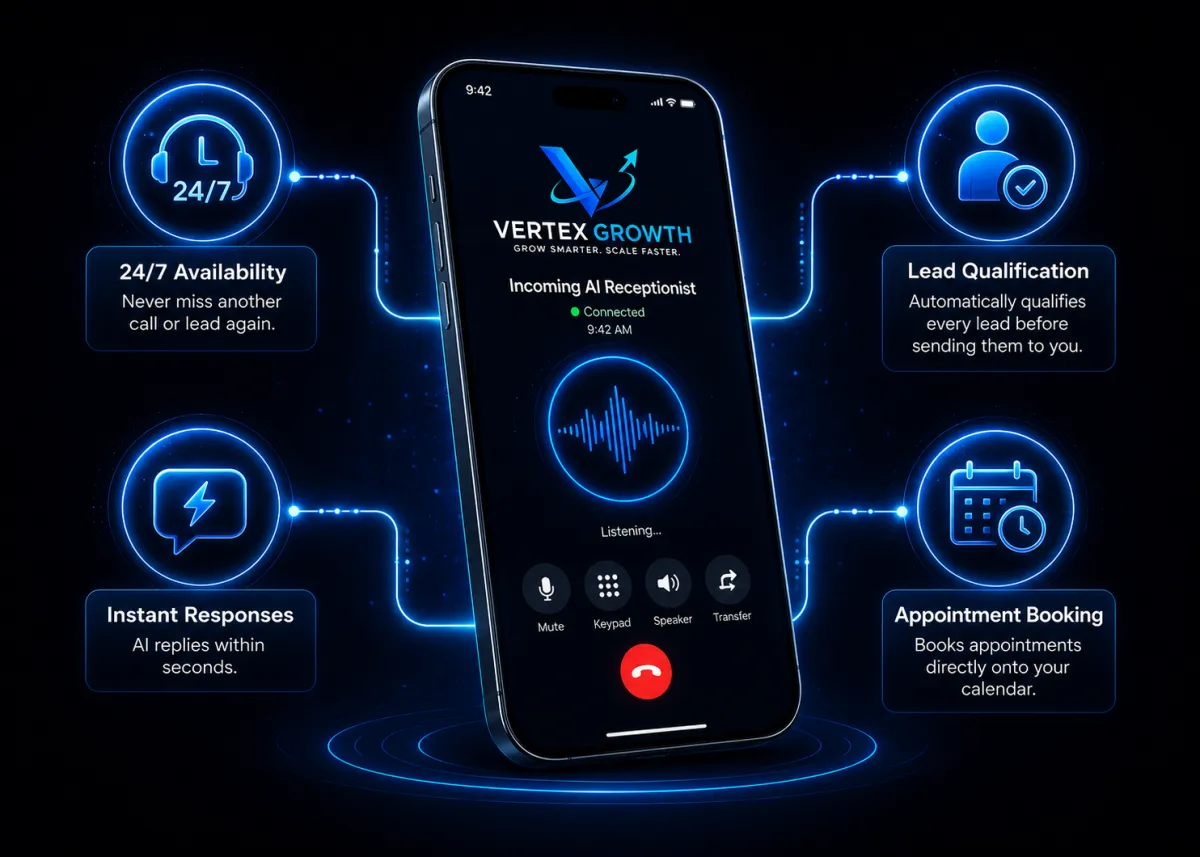
AI Receptionist
Your Business Never Stops.
Neither Does Your AI Receptionist
Capture every lead 24/7 with an intelligent AI receptionist that answers calls, responds instantly to texts and website chats, qualifies prospects, books appointments, and follows up automatically—so you never lose another customer to voicemail.
Answer calls 24/7
Replies instantly to text & website chats
Qualifies every lead automatically
Books appointments directly on your calendar
Sends reminders and follow-ups automatically
Integrates with your CRM automations
Helping Local Businesses Grow Every Day







What Our Clients Are Saying
Frequently Asked Questions
Do I have to sign a contract?
No. Every plan is month-to-month and you can cancel anytime.
How long does it take to build my website?
Most websites are completed within 7–14 business days.
Does the AI Receptionist answer calls?
Yes. It answers calls, texts, website chats, qualifies leads, and books appointments.
Can I keep my existing website?
Absolutely. We can improve your current website or build a completely new one.
Will my business show up on Google?
Yes. Every plan includes Google Business Profile optimization and Local SEO.
Do you provide support?
Yes. We provide ongoing updates, maintenance, hosting, and technical support.
Can I upgrade later?
Absolutely. You can upgrade to Rapid Growth or Accelerated Growth at any time.